The Expanded Universe content — all of them were written by people who believed in the galaxy they were tending.
The Thrawn Trilogy carefully expanded the saga — introducing new icons, naming Coruscant, and even surviving Luuke, whose mythic underpinnings were misguided but resilient.
The Knights of the Old Republic games offered the most thoughtful meditations on the Force and the Jedi.
Even the horror stories — Death Troopers and Red Harvest — bent the galaxy into survival horror, yet still spoke the old language of shadow, corruption, and resilience.
The grammar was mythic:
Heroes earned their arcs.
Mentors passed the legacy.
Lineage mattered, even when it was messy.
You could feel the affection, even when the execution faltered.
You could feel the devotion, even when the stories stumbled.
The old galaxy was built by people who believed in it.
The old caretakers spoke myth. They built with devotion, even when they stumbled. They believed the language mattered — lineage, patience, craft.
The new caretakers speak pipeline. They build with synergy, spectacle, brand. They believe the language is optional — that myth can be flattened into content.
It’s turning an oracle into a hype‑man.
The Old Language
Even the flawed prequels carried sincerity. The Expanded Universe novels, the comics, the games — all of them were written by people who believed in the galaxy they were tending.
The grammar was mythic:
Heroes earned their arcs.
Mentors passed the legacy.
Lineage mattered, even when it was messy.
You could feel the devotion, even when the execution faltered.
And when they diverted from myth — into horror, satire, or experiment — it was a deliberate choice, not a loss of fluency.
The New Language
Now the grammar is corporate:
Characters are assets.
Arcs are content beats.
Myth is flattened into spectacle.
Devotion is replaced by synergy.
The caretakers don’t speak the old tongue.
They don’t even try.
The Consequence
A myth can survive bad stories.
It cannot survive caretakers who no longer speak its language.
That’s the wound beneath the wound: not just a disappointing film, but a universe tended by stewards who don’t believe in its grammar.
The galaxy isn’t being rewritten.
It’s being mistranslated.
Closing Cadence
The old language was devotion, patience, lineage, craft.
The new language is synergy, spectacle, pipeline, brand.
Washed up. Ready to quit. Trains an apprentice who carries his legacy. Finds a new purpose.
Yes, I’m saying it. Yes, I’m talking about Cars 3. Yes, the movie where the protagonist is a sentient Chevy with performance anxiety.
I only watched Cars 3 because kids. I am a Star Wars fan… or was, anyway. Bought the art books, LEGO sets, comics, computer games… The universe works in mysterious ways, and is sometimes cruel. Sometimes it’s personal. So:
Somehow, this movie delivers the ageing‑hero arc that the most famous myth given form in cinema history absolutely fumbled.
Let’s break this down before Disney sends a fleet of lawyers riding speeder bikes (because FUCK ski speeders).
Lightning McQueen: The Washed‑Up Legend Who Actually Shows Up
Lightning starts Cars 3 in full midlife‑crisis mode. He’s getting smoked by a car that looks like a high‑end gaming mouse on wheels. His friends are retiring. His sponsors are eyeing younger models. He’s one bad race away from becoming a cautionary tale on ESPN8: The Ocho.
And what does he do?
He reflects.
He trains.
He eats humble pie like dessert.
He mentors Cruz because he sees her potential, not because the plot needs a checkbox ticked.
Lightning doesn’t run away to an island. Lightning doesn’t ghost the entire sport. Lightning doesn’t drink neon‑green milk straight from a space cow’s teat.
Lightning does the work.
Cruz Ramirez: The Apprentice Who Actually Has an Arc
Cruz is everything a well‑written next‑gen hero should be (whether she is fully realised or not is beside the point):
Underdog
Insecure
Talented but untested
Held back by the world, not elevated by destiny
Forced to train, fail, and try again
Her growth is earned. Her victory is earned. Her legacy is earned.
She doesn’t get powers because the universe thinks she’s quirky. She gets good because she works.
Imagine that.
Strong new heroes aren’t the problem — poorly written arcs are.
Meanwhile, in a familiar galaxy far, far away…
Luke Skywalker becomes “Jake” Skywalker the moment he decides the best way to handle trauma is to become a Force‑powered Airbnb host who hates guests.
He doesn’t mentor Rey. He doesn’t guide Rey. He doesn’t even like Rey.
Their dynamic is basically:
Rey: “Teach me.”
Luke: “No.”
Rey: “What if I stare at you?”
Luke: “Still no.”
Movie: “Anyway, she’s a Jedi now.”
Rey, for her part, is written like the universe’s favourite child:
Already powerful
Already special
Already mythic
Already good at everything except waiting her turn
There’s no lineage. There’s no craft. There’s no emotional baton pass. Just Girl Power™ without the character growth.
The Torch‑Passing Moment
Lightning’s handoff to Cruz is clean, earned, and kind of moving. He steps aside because he chooses to — not because the plot shoves him off a cliff.
Luke’s handoff to Rey is… what, exactly?
A Force Skype session and a guilt‑trip cameo.
Lightning becomes a mentor. Luke becomes a hologram.
Cruz becomes a racer. Rey becomes a symbol.
One pair feels like a lineage. The other feels like a reboot.
Lightning completes the Return — and brings the elixir back with him. Luke never does. One story believes the hero’s final duty is to teach; the other believes it’s to disappear.
The Irreverent Thesis, Now Fully Justified
Cars 3 — the movie about sentient automobiles — delivers a more coherent, emotionally satisfying, mentor’s hero’s journey than the sequel trilogy that inherited the most famous myth given form in cinema history.
Lightning grows. Cruz grows. The legacy grows.
“Jake” sulks. Rey ascends. The legacy… what legacy.
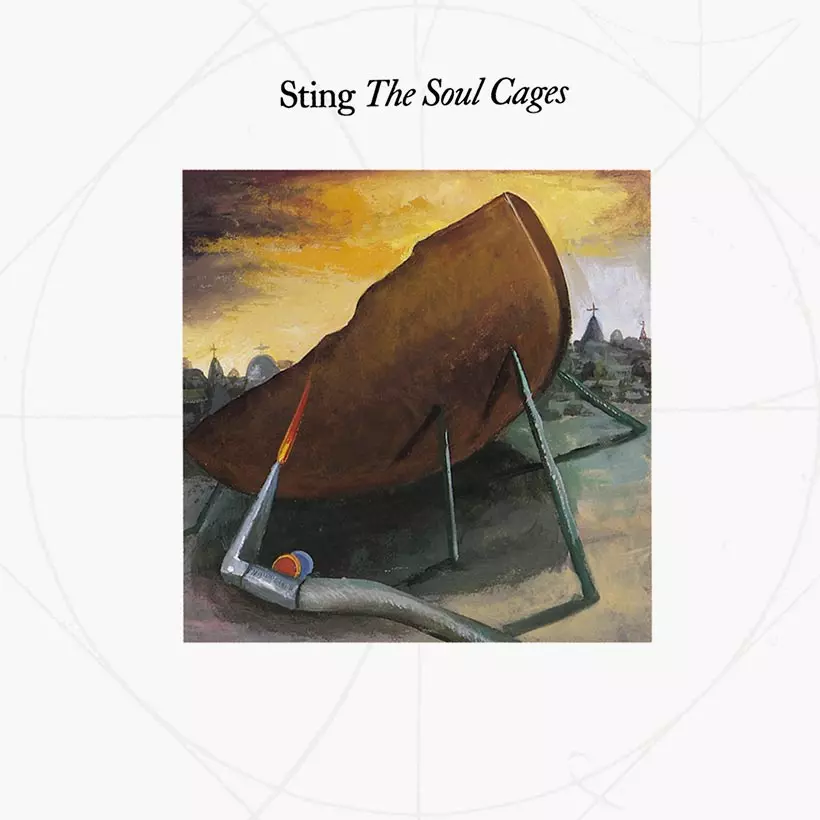
There are albums you listen to casually, and then there are albums that arrive when your heart is torn open. The Soul Cages became that for me. I had heard Sting’s work before, but it wasn’t until after my father died that this album felt like it had been quietly waiting for me. Suddenly it wasn’t just art anymore — it was a reflection of everything I was wrestling with: grief, identity, the tension between inherited faith and personal belief, and the complicated weight of a father–son relationship.
A Quiet Religion, A Quiet Distance
Religion was never something my father enforced. It wasn’t preached or demanded. It was just there. We were Christians. Not spoken aloud, just expected.
But as I grew older, that inherited faith stopped fitting as neatly. Not in an angry, rebellious way — simply a drifting, a quiet mismatch between what I was told we were and what I actually felt. It created a faint friction — a distance. Conversations we lacked the vocabulary for, left unspoken.
It never came naturally to me. Eventually I realised it had never come at all — that what I called belief was simply me acting the part.
My relationship with my father was much the same: loving, present, but with long, unspoken stretches. He was a part of my life in a way that felt foundational but also unreachable — like a landscape I could always see but never fully map.
My father was a man of severe moral convictions, the kind that didn’t bend with circumstance. But he never imposed that code on anyone else — he held only himself to its full weight. He grew up under the Japanese occupation, and while my family’s hometown was too small for the soldiers to bother with, the self‑sufficiency and iron‑will he forged in those lean years stayed with him for life. His honour was everything to him. He loved old westerns and wuxia shows because their worlds made sense to him — right was right, wrong was wrong, and a man stood by his word. He seemed almost mythical, like an archetype from a bygone era. That clarity shaped him, but it also cost him. He had a great career, yet we weren’t left with much in the end, in part because of that same honour and a stubborn pride he wouldn’t — he couldn’t — set down.
The Myth That Became Personal
When I returned to The Soul Cages, I was struck by how much Sting’s myth‑making echoed what I couldn’t articulate. The imagery of harbours, deep water, storms, shipyards — a son diving into the dark to wrestle with grief and reclaim something of his father. And in listening to it now, I realise I’m doing the same — trying to reclaim something of my father for myself, something more human than the idealised figure I carried for years.
And for me, one detail hit harder than I expected:
Billy longed to bury his father at sea. I did. We committed my father’s ashes to the waters — as he had asked in his will — near his beloved hometown, far from the home he built for most of his life, and where I still live.
There is something disorienting about committal to the sea. No niche to visit, no urn. Just the horizon, the water, the currents. Grief becomes unmoored, and so do you. That distant shoreline is not a casual return.
When Sting sang of Billy wishing he could cast his father into the ocean, it wasn’t the image that pierced me — it was the recognition. That strange, weightless moment when you realise you’re releasing the last physical evidence of him into something in constant change.
Faith, or the Space Where Faith Used To Live
My struggle wasn’t with imposed doctrine — my father never pushed religious weight onto me. It was more a lingering question: what do you do with a faith that was inherited as identity, not conviction? What happens when it no longer feels like your story, but still feels tied to your father’s?
The Soul Cages gave shape to that tension. It captured a spiritual exhaustion — not anger, not rejection, just a tired reaching that never resolves.
In Sting’s narrative, the son is wrestling not just with grief, but with the spiritual structures surrounding his father’s life and death. That resonated deeply with me. I wasn’t fighting religion; I was untangling myself from a framework I didn’t fully inhabit.
It was comforting, in a quiet way, to hear someone else wrestling with inherited belief, trying to reconcile love, loss, and identity without answers, only the slow work of acceptance.
A Language for What I Couldn’t Say
Grief after the funeral — after the sea takes the last physical trace — becomes a very internal thing. There’s no ritual to anchor the days. Just memory and silence. He specifically wanted a sea funeral because he hated any ceremony. With children, and the general chaos of life, I’ve forgotten the yearly Guinness a few times over the years. I think he would have been okay with that.
The Soul Cages became a map for that silence. I didn’t find closure in it, but I did find a language — a way to hold my father in my thoughts without drowning in the unresolved parts of our relationship.
The album reminded me that grief isn’t about resolving everything. It’s about learning to coexist with the things you couldn’t say, the questions you never asked, the parts of him that live in you whether you wanted them to or not.
Still Diving
Years later, I still return to The Soul Cages. Not out of sadness, but out of recognition. Out of respect for that time in my life when the sea took something from me, and music gave me something back.
I listen the way you check in on an old scar — no longer painful, almost comforting in its familiarity. This album taught me that grief isn’t something you get over, but something you learn to live with.
I don’t know if I’ve freed anything from its “soul cage.” I just know I’ve learnt how to carry him, like the tides carry him.
There’s this projection I had with Andy, Kurt, Jeff Buckley and other friends of mine that died of looking into the future at all these amazing things they’re going to do. I’ll never be able to predict what that is.
Chris Cornell
When Bowie died last year, I felt an incredible sense of loss. I did not grow up with his music, but his was arguably the most important oeuvre in my young adulthood as I went through the usual search for identity and my place in the world.
In my formative years though, it was the 90s Seattle bands and their ilk that had my devotion: Pearl Jam, Mudhoney, Nirvana, Alice In Chains and, of course, Soundgarden. Many of my heroes from that era have already been taken from us, but none hurt like this one. Kurt Cobain, killed himself so early I could only have processed that through my teenage angst. Layne Staley, tragic and inevitable. Mike Starr, sadly forgotten. Chris Cornell, though, accompanied my long stumble into adulthood (some say I’m still stumbling) and I was looking forward to growing old with his music.
When news first broke we were all thinking the years of abuse must have taken their toll. Then it turned out it was suicide and we could scarcely believe it. We thought that maybe he was one of the few who made it through to a better place. That perhaps his seeming comfort with being the full-throated, bare-chested metal god just might be able to overcome the darkness he seemed to have shared with his peers. His wife thinks the drug antianxiety drug Ativan caused him to kill himself. Did he have too much of it? Did his dark lyrics that helped me and countless others make it fail to heal his own soul and the drug nudged him over the edge into the abyss? Or maybe it wasn’t even the drug, maybe this was a long time coming.
And now one of the greatest voices of his generation is gone. I would give a lot to be like a teenager in the 90s again, when every few months it seemed an album would come along and blow my plastic, impressionable mind. Even so, the trio of Superunknown, Badmotorfinger and Louder Than Love were thunderclaps in an overcast sky of amazing music.